
Venture Debt Structures: Amortizing vs. Bullet Financing Explained

Venture debt is a popular financing option for startups, offering a way to extend runway, finance growth, and reducing or removing equity dilution. Two primary structures dominate this space: amortizing and “bullet” financing. Understanding the differences between these structures is crucial for choosing the right option for your business.

Chart illustrating amortizing versus bullet-repayment venture debt structures

Table of Contents

Venture debt is a popular financing option for startups, offering a way to extend runway, finance growth, and reducing or removing equity dilution. Two primary structures dominate this space: amortizing and “bullet” financing. Understanding the differences between these structures is crucial for choosing the right option for your business.

‍

What Is Venture Debt?

Venture debt is a type of financing provided to early-stage companies, which typically have existing equity investments from venture capital funds (ie “Sponsors”). Unlike traditional venture capital, which involves giving up equity, venture debt allows startups to raise funds while retaining ownership. Common use cases include extending runway, scaling growth, geographical expansion and completing accretive acquisitions. Venture debt may act as an alternative to equity capital or may complement it as part of a larger fundraising round or strategy.  There are a multitude of different venture debt structures in the marketplace and good reason for the variety.  One of the major differentiators is whether the structure is an amortizing one or a “bullet”. We will explore this differentiating factor in this article. 

‍

Amortizing Financing Structures

Amortizing financing involves regular payments of principal and interest over the term of the financing – it may be monthly, quarterly, semi-annually or annually. This structure offers a predictable payment schedule, reducing outstanding debt over time and in an orderly fashion. However, it requires higher cash flow during the repayment period, which can divert capital from growth initiatives. Amortizing financing is best suited for companies with steady revenue streams or early-stage startups managing cash conservatively.

‍

Bullet Financing Structures

“Bullet” financing requires the principal to be repaid in full at the end of the loan term, with periodic interest-only payments. This structure allows for lower cash outflow during the term, reserving cash for growth. However, it necessitates a large lump-sum repayment at maturity, requiring careful financial planning. Bullet financing is ideal for growth-stage startups with upcoming fundraising or exit opportunities, which can be used to repay the liability in full. As fundraising or exit opportunities play a prominent role in the borrower’s ability to repay the liability, this is often times a structure more aligned with borrower’s who have Sponsors on the cap table already. 

‍

Key Considerations When Choosing a Structure

‍

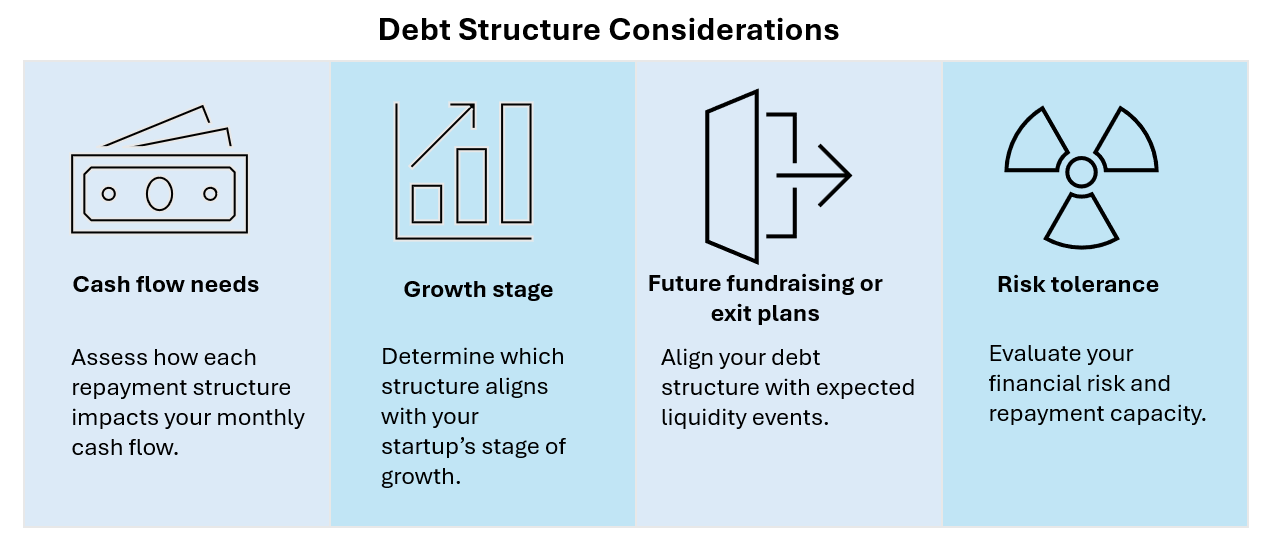
When deciding between amortizing and bullet financing, consider the following factors:
‍

Lessons for Founders

‍

To make an informed decision, conduct a financial forecast to understand your repayment capabilities. Negotiate terms that align with your growth trajectory and risk appetite. Thoughtful planning and consultation with financial advisors can help ensure that your chosen venture debt structure supports sustainable growth.

‍

Understanding the differences between amortizing and bullet financing structures is essential for making the right choice for your business. By choosing venture debt wisely, founders can support sustainable growth and achieve their business goals. Thoughtful planning and consultation are key to navigating this complex landscape successfully.

‍

‍

A Third Structure Worth Considering

Amortizing and bullet aren’t the only two shapes venture debt can take. Pershing Ventures offers revenue-based growth financing — US$50,000 to US$1,000,000, with repayments set as a pre-agreed percentage of monthly revenue rather than a fixed amortization schedule or a lump-sum bullet at maturity. There is no fixed maturity date at all, so a slower month doesn’t create the same repayment cliff a bullet structure can, and there’s no need to have Sponsors already on the cap table to qualify. Every deal is reviewed by a human Investment Committee, and the capital is permanent rather than tied to a fund’s life cycle.

‍

See if your business qualifies for non-dilutive growth capital →

More Insights

Founder demonstrating leadership traits that attract investor confidence

Beyond Ideas: Leadership Traits to Attract Diverse Funding

In the competitive world of entrepreneurship, venture capitalists (VCs) and other funding sources are not just investing in innovative ideas—they're investing in the people behind those ideas. The leadership qualities of founders play a crucial role in attracting interest and securing funding. Here’s a closer look at the traits that make founders stand out.

Scale weighing debt financing against equity financing options

Debt vs. Equity: Which Funding Option Is Right for Your Business?

Securing the right funding is one of the most crucial decisions a business can make. Whether you're launching a startup, scaling an existing company, or entering a new market, how you finance your growth will significantly impact your operations, ownership, and long-term trajectory. Two primary funding options exist: debt financing and equity financing. Each has distinct advantages and trade-offs, making it essential for founders and business owners to understand their differences before choosing the best path forward.

Comparison of bank, non-bank financier, and credit fund organizational structures

Does Your Creditor's Structure Matter? Comparing Funding Services

When seeking financing, the organizational structure of your creditor can significantly impact the terms, flexibility, and overall experience of your financial relationship. Understanding the differences between banks, non-bank financiers, and credit funds can help you make informed decisions that align with your business needs.

Split illustration comparing fintech app-based lending with traditional bank lending

FinTech disruption vs. Traditional lending: A comparative insight

The landscape of debt financing is evolving rapidly, offering businesses more options than ever before. The rise of fully automated financiers—such as fintech platforms—has disrupted the traditional lending industry, promising faster access to capital with minimal paperwork. Meanwhile, traditional lenders—such as banks—continue to provide structured financing with lower interest rates but stricter requirements.

Founder reviewing revenue growth charts while considering revenue-based financing

Funding That Scales With You Why Founders Are Choosing Revenue-Based Financing

In the ever-evolving landscape of startup financing, a significant shift is underway. Many founders are moving away from the allure of venture capital (VC) checks and are instead seeking financing partners that offer growth capital tailored to their business model. This trend is driving the rise in revenue-based financing as an efficient and scalable alternative, providing businesses with the resources they need without sacrificing control or ownership

Upward-trending growth chart representing a business scaling from $1M to $10M in revenue

Scaling Smarter: Financing Options to Grow from $1M to $10M

Scaling a business from $1M to $10M is a significant challenge that requires strategic planning and the right financing strategy. Selecting the right funding is essential for sustainable growth and can determine whether a business thrives or fails. Here, we explore pragmatic funding options that balance risk, growth, and control.

Founder reviewing a financing contract to check for hidden fees and terms

The Hidden Price of 0% Down: What Every Founder Should Know

The allure of starting or scaling a business with no upfront investment is tempting. However, the reality of "0% down” often masks hidden costs, risks, and trade-offs. Here's what every founder should know.

Business owner weighing the pros and cons of working with multiple debt providers

The Pros and Cons of Using Multiple Debt Sources to Fund Your Growth

For businesses looking to scale, access to funding is often the key to unlocking growth. While debt financing is a common tool, some companies consider working with multiple debt providers to diversify their funding sources. But is this approach the right move? 

Founder pitching to investors, illustrating the narrow odds of securing venture capital funding

The VC Gap: Why Only 0.04% of Startups Secure Venture Funding

Every year, millions of founders launch startups, hoping to turn their ideas into successful businesses. In 2024 alone, over 5.2 million new companies were registered in the U.S., according to the Census Bureau. But here’s the hard truth—only a tiny fraction will ever secure venture capital. In fact, just 0.04% of startups secure the funding they need to scale.

Chart illustrating amortizing versus bullet-repayment venture debt structures

Venture Debt Structures: Amortizing vs. Bullet Financing Explained

Venture debt is a popular financing option for startups, offering a way to extend runway, finance growth, and reducing or removing equity dilution. Two primary structures dominate this space: amortizing and “bullet” financing. Understanding the differences between these structures is crucial for choosing the right option for your business.

By clicking “Accept”, you agree to the storing of cookies on your device to enhance site navigation, analyze site usage, and assist in our marketing efforts. View our Privacy Policy for more information.